

AI - Assisted Designs
Updated: Apr 25
The world is constantly evolving, introducing new ways to improve quality of life and more efficient ways of working. This ongoing shift challenges me to adapt, finding better processes and embracing new technologies to enhance how I design and create. As a designer and maker, I’m always looking for opportunities to streamline traditionally time-consuming workflows without compromising quality.
This led me to explore the use of artificial intelligence as a tool within my practice. By integrating AI into my design process, I’m able to support ideation, accelerate iteration, and approach problem-solving from new perspectives. In this section, I document my learning journey, showcasing how AI has influenced the way I think, work, and develop solutions. This self-driven exploration highlights how AI can improve efficiency, elevate outcomes, and ultimately strengthen my role as both a designer and a maker.
As urban density continues to increase, living spaces are becoming progressively smaller. While this shift creates opportunities for more efficient living, it also introduces everyday challenges, especially when it comes to storage. In my own experience living in a small apartment, managing frequently used items becomes difficult, often leading to cluttered and disorganized spaces.
One specific challenge I identified is the storage of in-between items, small belongings and clothing that are clean but not clean enough to return to the closet. These items often end up draped over chairs or placed in baskets, making the space feel cluttered, harder to navigate, and visually unappealing.
This project focuses on designing a storage solution tailored to these conditions: a system that accommodates small items and lightly worn clothing, minimizes spatial impact, and enhances the overall aesthetic of the environment. The goal is to create a solution that not only improves organization, but also contributes to a cleaner, more intentional living space.
After researching about this topic storage for small spaces. I use prompts to guide AI tools like ChatGPT in generating early-stage ideas and rough directions. This approach helps me quickly explore a wide range of concepts, providing visual cues and new perspectives that inform my design thinking. By leveraging AI at this stage, I’m able to cast a broad net, identifying promising directions faster and focusing my efforts on refining the most viable solutions.

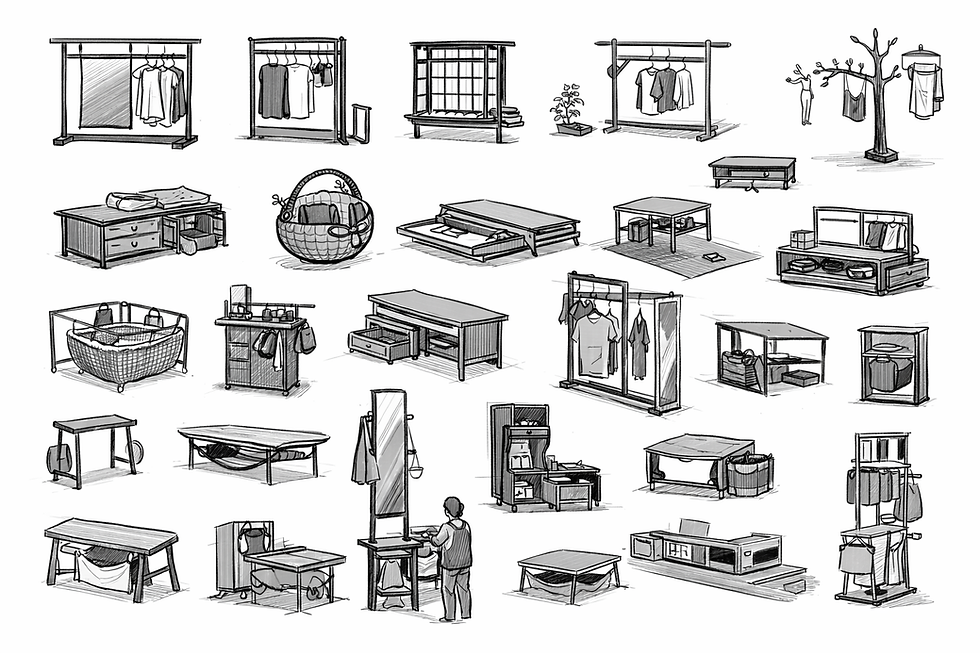

I like to push ideation in multiple directions, using AI to generate a mix of creative, conservative, and even unrealistic concepts. Some of these ideas may not be feasible, but they often contain elements or details that can spark new directions. After reviewing the initial batch of sketches, I typically select 10–20 concepts that stand out, whether it’s the overall form, a specific component, or a small detail worth exploring further.
In the iteration stage, I continue working with AI, but with more focused prompts. This allows me to refine and narrow down specific elements, gradually shaping and aligning the ideas into a more cohesive and intentional design direction.

From the iterations I can see that the forms are starting to take its shape. I have a more direct answer. I can be more intentional with the decisions from here, I can again select a few sketches that speaks to me, something that pertains the original problem I wanted to solve -a system that accommodates small items and lightly worn clothing, minimizes spatial impact, and enhances the overall aesthetic of the environment.
From the iteration, here are the pieces that speak out to me. (2) The shoji screen-inspired concept stood out to me as it addresses both storage and spatial experience, especially in smaller living environments. In compact spaces, it’s important to create a sense of separation and privacy without introducing heavy, permanent walls that can make the area feel constrained. A shoji screen offers that flexibility, it subtly divides space while maintaining openness and lightness.
What makes this direction compelling is the integration of function within the form. By incorporating cross members into the frame, the structure naturally becomes a storage system for hanging garments and organizing everyday items. These elements feel intentional and cohesive, rather than added on, allowing the piece to maintain a clean visual language. At the same time, the screen helps conceal visual clutter, contributing to a calmer and more organized environment.

(4) The tree-inspired storage concept stood out to me because of its organic and sculptural qualities. Forms like this naturally feel more inviting and calming, bringing a subtle sense of nature into the space without requiring actual plants or additional maintenance. It creates an emotional connection, something that feels softer and more approachable compared to typical rigid storage solutions.
While the initial sketch leans more toward expression than practicality, with limited storage capacity and a larger footprint. I see strong potential in this direction. The concept is visually engaging and has a distinct presence, which makes it memorable. With further iteration, there is an opportunity to refine the form, improving its efficiency and functionality while preserving the organic language that makes it compelling.
The goal moving forward is to find a balance between form and function, maintaining the fluid, nature-inspired silhouette while introducing more intentional storage moments and a more considered use of space

After completing these exploratory exercises with AI, I begin translating selected concepts into early-stage models in SolidWorks. These initial CAD models are developed from the most promising ideas, allowing me to refine forms and move from loose sketches into more defined geometry. At this stage, I establish rough dimensions, explore how components come together, and begin resolving the structure and assembly. This process helps narrow down the organic forms and sets a clear foundation for further refinement and production-ready development.
From this process, the shoji screen-inspired concept emerged as the strongest direction due to its ability to address both spatial division and integrated storage. I focused on carrying forward the core qualities identified during the AI exploration, lightness, modularity, and multifunctionality, while beginning to resolve them into a more intentional and buildable form. This transition from concept to early CAD allowed me to test proportions, clarify the structural framework, and explore how storage elements could be seamlessly embedded within the design. The result is an initial rendering that reflects a more refined interpretation of the idea, where aesthetic inspiration and practical functionality begin to align.


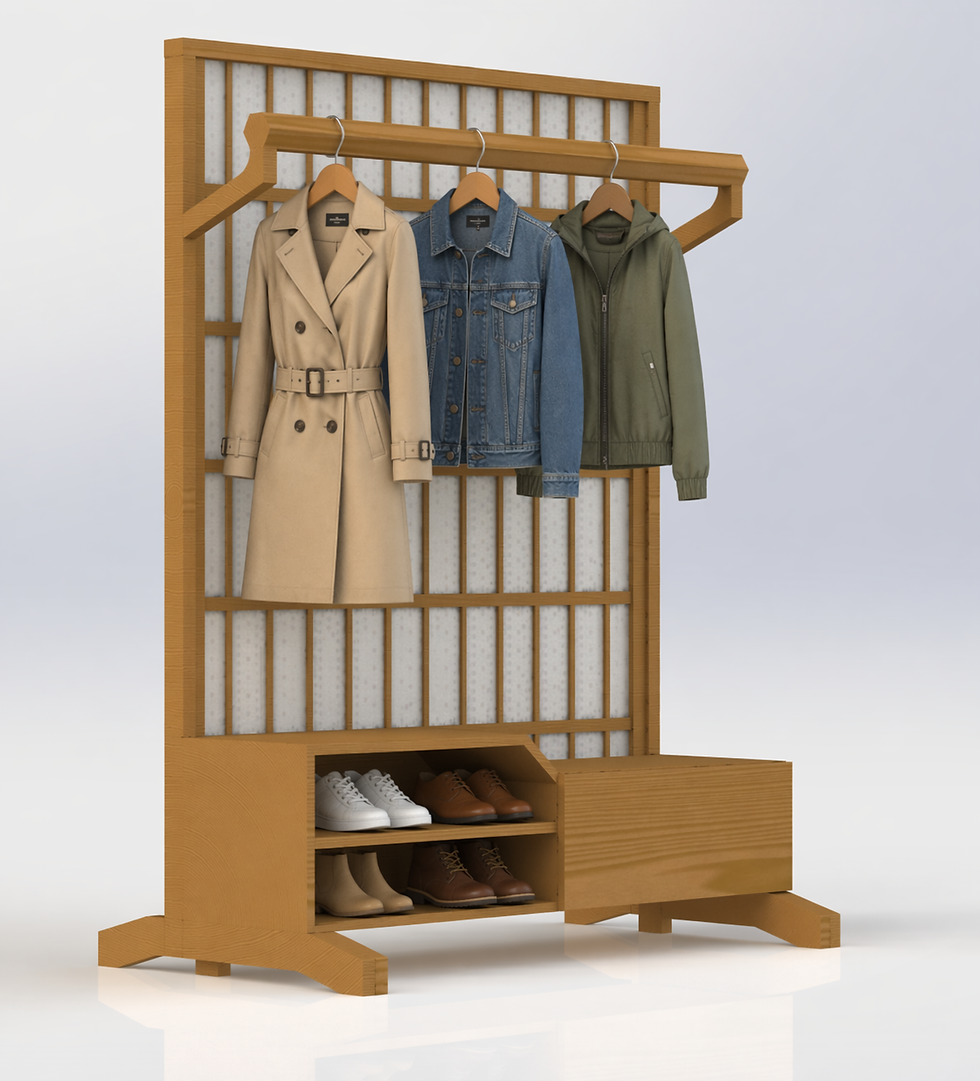
This project reflects my approach to integrating emerging tools with hands-on design thinking, using AI to expand possibilities while grounding every decision in real-world application. Through this process, I was able to move efficiently from broad exploration to a focused, buildable concept, balancing spatial experience with functional storage. It demonstrates how I translate abstract ideas into intentional designs, refining them through iteration, technical development, and consideration of how they will exist and perform in everyday environments.

Comments